Introduction
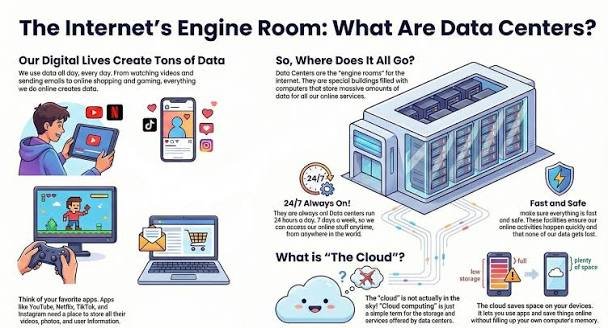
In today’s digital world, almost everything we do depends on data. From sending emails and watching videos to shopping online, using banking apps, storing photos, and working with cloud-based software, digital information is constantly being created, processed, and stored. Behind many of these everyday activities are powerful facilities known as data centers.
A data center is a specialized facility that houses servers, storage systems, networking equipment, power systems, cooling infrastructure, and security technologies. These facilities provide the computing resources needed to run websites, applications, databases, cloud platforms, artificial intelligence systems, and many other digital services.
As businesses become more dependent on technology, data centers have become an essential part of modern infrastructure. This article explains what data centers are, how they work, their major components, different types, security requirements, energy challenges, and their future role in technologies such as artificial intelligence and edge computing.
What Is a Data Center?
A data center is a physical location designed to store and operate computer systems and related equipment. Its primary purpose is to provide reliable computing, storage, and networking resources.
A small data center may contain a few racks of servers, while a large facility operated by a major technology company may contain thousands of servers spread across a huge building.
Data centers support many activities, including:
- Hosting websites and applications
- Storing business information
- Running cloud services
- Processing online transactions
- Managing databases
- Supporting artificial intelligence
- Providing backup and disaster recovery
- Delivering streaming and online content
Although users may interact with digital services through a phone or computer, the actual processing often takes place inside a data center.
Why Are Data Centers Important?
Modern businesses rely heavily on digital infrastructure. Companies need technology to communicate with customers, manage employees, process payments, store documents, and operate applications.
Without reliable data centers, many online services would not function properly.
For example, when someone purchases a product from an online store, several systems may work together. The website needs to display product information, check inventory, process payment details, create an order, and update the database. These operations require computing resources that are typically hosted in data centers.
Data centers also support cloud computing. Instead of purchasing physical servers, businesses can rent computing and storage resources from cloud providers. The physical infrastructure behind these services is located in data centers.
Main Components of a Data Center
A modern data center contains several important systems that work together.
Servers
Servers are the primary computing machines inside a data center. They process applications, manage databases, host websites, and perform many other tasks.
Modern servers can contain powerful processors, large amounts of memory, high-speed storage, and specialized hardware for demanding workloads.
Storage Systems
Data centers need large amounts of storage for files, databases, backups, applications, and other information.
Storage may include hard drives, solid-state drives, storage arrays, and distributed storage systems. Different technologies are selected depending on the required speed, capacity, reliability, and cost.
Networking Equipment
Servers need to communicate with each other and with users outside the facility. Switches, routers, firewalls, load balancers, cables, and optical connections form the networking infrastructure.
High-speed networking is particularly important for large facilities and artificial intelligence workloads.
Power Systems
Reliable electricity is essential for a data center. Even a short interruption can cause serious problems for critical applications.
Data centers commonly use uninterruptible power supplies, batteries, backup generators, power distribution equipment, and redundant electrical systems.
These systems help keep equipment running if the primary electricity supply fails.
Cooling Systems
Servers generate significant amounts of heat. Without effective cooling, equipment can overheat and become damaged.
Traditional facilities often use air-based cooling systems, while modern high-density environments increasingly use liquid cooling.
Cooling can include fans, air conditioning systems, chilled water, heat exchangers, cooling towers, and liquid cooling systems.
Types of Data Centers
There are several types of data centers, and each is designed for different requirements.
Enterprise Data Centers
An enterprise data center is operated by an organization for its own computing needs. Banks, universities, government agencies, manufacturers, and large companies may operate private facilities.
This approach provides greater control over hardware and infrastructure but can require significant investment and technical expertise.
Colocation Data Centers
A colocation facility allows multiple companies to place their own servers and networking equipment in a professionally managed facility.
Customers rent physical space and typically pay for power, cooling, connectivity, and other infrastructure services.
Colocation can be useful for businesses that want control over their hardware without building an entire data center.
Cloud Data Centers
Cloud providers operate large networks of data centers that deliver computing resources through the internet.
Customers can use virtual machines, storage, databases, networking, artificial intelligence tools, and other services without managing the physical infrastructure themselves.
Cloud computing has made advanced computing resources available to businesses of many different sizes.
Hyperscale Data Centers
Hyperscale data centers are designed for extremely large computing operations. They may contain enormous numbers of servers and are optimized for scalability, automation, efficiency, and reliability.
These facilities are particularly important for large cloud platforms, internet services, and artificial intelligence applications.
Edge Data Centers
Edge data centers are smaller facilities located closer to users or devices.
Their purpose is to reduce latency by processing information closer to where it is generated or consumed.
Edge computing can be useful for applications such as industrial automation, smart cities, gaming, telecommunications, and Internet of Things devices.
Data Center Security
Security is one of the most important aspects of data center management.
Because these facilities contain valuable equipment and sensitive information, operators need to protect them from physical and digital threats.
Physical security can include security guards, surveillance cameras, access cards, biometric authentication, restricted areas, perimeter fencing, and visitor management systems.
Cybersecurity is equally important. Data centers may use firewalls, encryption, multi-factor authentication, network segmentation, intrusion detection, security monitoring, and access controls.
A strong security strategy uses multiple layers of protection rather than depending on a single security technology.
Data Center Reliability
Businesses often expect their digital services to remain available around the clock. For this reason, reliability is a major priority.
Data centers use redundancy to reduce the impact of equipment failures.
For example, a facility may have multiple power sources, backup generators, redundant cooling equipment, multiple network connections, and additional servers.
If one component stops working, another component may continue providing the required service.
This approach helps reduce downtime and improves overall system resilience.
Data Centers and Energy Consumption
Data centers require large amounts of electricity. Power is needed for servers, storage, networking equipment, cooling, lighting, security systems, and other infrastructure.
As computing workloads become more demanding, energy efficiency has become increasingly important.
Operators can improve efficiency through better cooling systems, efficient processors, renewable energy, improved power supplies, virtualization, and intelligent workload management.
Many organizations are also exploring renewable energy sources such as solar and wind power to reduce the environmental impact of their operations.
Data Centers and Artificial Intelligence
Artificial intelligence is changing the data center industry.
AI applications can require powerful processors, large amounts of memory, fast networking, and substantial electricity. Training advanced AI models can involve thousands of processors working together.
These workloads also generate considerable heat, creating additional cooling requirements.
As AI continues to expand, data centers are being designed with higher power densities and more advanced cooling systems.
Liquid cooling is becoming particularly important for high-performance computing because liquid can transfer heat more efficiently than air in many applications.
Data Backup and Disaster Recovery
Data loss can be extremely damaging to businesses. Hardware failures, cyberattacks, accidental deletion, natural disasters, and other incidents can make information unavailable.
Data centers therefore play an important role in backup and disaster recovery strategies.
Organizations may maintain copies of important information in separate locations. Some businesses also operate backup infrastructure in another geographic region so that a major incident at one facility does not affect every copy of their data.
A good backup strategy should include regular backups, appropriate retention policies, secure storage, and regular testing to make sure information can actually be restored.
The Future of Data Centers
The future of data centers will be influenced by artificial intelligence, cloud computing, edge computing, automation, and sustainability.
AI will continue increasing demand for high-performance infrastructure. This will encourage the development of more efficient processors, advanced networking, and improved cooling systems.
Edge computing is also likely to become more important as applications require extremely fast responses. Instead of sending every piece of information to a distant facility, some processing can happen closer to users and connected devices.
Automation will also play a larger role. Software can monitor equipment, detect unusual behavior, manage workloads, and optimize energy consumption.
Sustainability will remain another major focus. As data center electricity demand grows, operators will look for ways to reduce energy consumption and increase the use of renewable power.
Conclusion
Data centers are the hidden foundation of much of modern digital life. Every day, people depend on them for online shopping, banking, communication, entertainment, cloud services, business applications, and countless other activities.
These facilities combine servers, storage, networking, power, cooling, security, and monitoring systems to provide reliable computing infrastructure.
As technology continues to evolve, data centers will become even more important. Artificial intelligence is creating new requirements for computing power and cooling, while edge computing is encouraging more distributed infrastructure. At the same time, businesses and technology providers are working to improve efficiency, reliability, security, and sustainability.
Whether it is a small enterprise facility or a massive hyperscale campus, a well-designed data center allows digital services to operate efficiently and reliably. As our dependence on technology continues to grow, the importance of data centers will only become greater.