
Introduction
Cloud compliance has become an essential part of modern business operations as organizations increasingly depend on cloud computing services. It helps companies protect sensitive information, follow industry regulations, and maintain secure digital environments. Businesses store large amounts of data online, making it important to understand how this information should be managed and protected. Cloud compliance provides a framework for meeting legal, regulatory, and security requirements. By implementing appropriate compliance practices, organizations can reduce risks and build stronger relationships with customers. Understanding cloud compliance is an important step toward achieving long-term digital security and business success.
1. What Is Cloud Compliance?
Cloud compliance refers to the process of ensuring that cloud-based systems, applications, and data follow applicable laws, regulations, industry standards, and organizational policies. It helps businesses maintain responsible practices while using cloud platforms to store and process information. Organizations must understand which compliance requirements apply to their operations and industry. These requirements may cover data protection, privacy, access management, and security monitoring. Cloud compliance also involves reviewing cloud environments regularly to identify potential weaknesses. A well-planned compliance strategy allows businesses to operate more confidently while protecting their digital resources.
2. Importance of Cloud Compliance
Cloud compliance is important because businesses must protect information while meeting their legal and professional responsibilities. Failure to follow relevant requirements can result in financial penalties, legal disputes, and damage to a company’s reputation. Compliance practices help organizations establish clear rules for managing data and controlling access to cloud resources. They also encourage employees to follow secure procedures when handling confidential information. Customers are more likely to trust businesses that demonstrate responsible data management. By making compliance a priority, organizations can strengthen their security practices and create a more reliable cloud environment.
3. Major Cloud Compliance Standards
Several recognized standards and regulatory frameworks help organizations manage compliance in cloud environments. ISO 27001 provides a framework for establishing and improving information security management systems. SOC 2 evaluates controls relevant to areas such as security, availability, confidentiality, processing integrity, and privacy. The General Data Protection Regulation (GDPR) establishes requirements for handling personal data within its applicable scope. The Health Insurance Portability and Accountability Act (HIPAA) includes requirements relevant to protecting health information in the United States. Organizations may also need to consider PCI DSS when processing payment card data. The appropriate standards depend on the company’s location, industry, customers, and business activities.
4. Cloud Compliance and Data Security
Data security is a major part of cloud compliance because organizations must protect information against unauthorized access, loss, and misuse. Businesses can use encryption to protect data while it is being transferred and stored. Strong authentication methods help prevent unauthorized individuals from accessing cloud accounts. Access permissions should be assigned according to each employee’s responsibilities. Regular security assessments can reveal weaknesses before they become serious problems. Companies should also maintain reliable backup procedures and establish plans for responding to security incidents. Combining these measures with suitable compliance controls helps organizations protect sensitive information more effectively.
5. Common Cloud Compliance Challenges
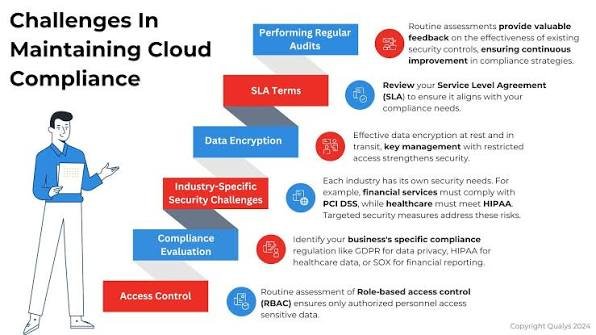
Organizations may experience several challenges when trying to maintain cloud compliance. Different countries and industries can impose different requirements, making it difficult for international businesses to manage every obligation. Cloud environments may also contain multiple services, applications, and storage locations that require consistent oversight. Misconfigured security settings can expose sensitive information or create compliance gaps. Limited employee awareness may lead to unsafe data-handling practices. In addition, organizations may struggle to understand which responsibilities belong to the cloud provider and which remain with the customer. Identifying these challenges early helps businesses develop practical solutions and improve their compliance programs.
6. The Shared Responsibility Model
The shared responsibility model explains how cloud providers and customers divide security and compliance responsibilities. Cloud providers generally manage aspects of the underlying infrastructure, such as physical facilities and certain platform components. Customers remain responsible for tasks that depend on their chosen service and configuration, including identity management, data classification, and access permissions. The exact division varies between infrastructure, platform, and software cloud services. Businesses should carefully review their provider’s agreements, security documentation, and compliance reports. Understanding this model prevents organizations from assuming that a cloud provider automatically handles every compliance obligation. Clear responsibility assignments make cloud governance more effective.
7. Cloud Compliance Risk Management
Risk management helps businesses identify, evaluate, and reduce threats that could affect their compliance status. The process begins by identifying sensitive information, important cloud assets, and applicable regulatory requirements. Organizations can then assess potential risks, including unauthorized access, data loss, and service interruptions. Each risk should be evaluated according to its likelihood and possible impact. Appropriate controls can be introduced to reduce the most significant risks. Businesses should document their decisions and review risk assessments whenever their cloud environment changes. Continuous risk management supports better decision-making and helps organizations maintain compliance as their technology and operations evolve.
8. Role of Automation in Cloud Compliance
Automation can make cloud compliance easier to manage by reducing repetitive manual tasks. Automated tools can monitor configurations, detect policy violations, and generate alerts when cloud resources do not meet established requirements. Some platforms also provide dashboards that help teams track compliance activities and prepare evidence for assessments. Infrastructure-as-code policies can help organizations apply approved configurations consistently when deploying cloud resources. However, automated tools should be configured carefully and reviewed by qualified personnel. Automation does not replace human judgment or remove the need to understand regulatory obligations. When used appropriately, it improves visibility, consistency, and efficiency across cloud environments.
9. Cloud Compliance Audits
Cloud compliance audits help organizations determine whether their systems and processes meet relevant requirements. An audit may involve reviewing security policies, access records, configuration settings, incident reports, and evidence of employee training. Internal audits allow businesses to identify problems before an external assessment takes place. Independent assessments may also be required by customers, regulators, or particular industry standards. Organizations should maintain accurate documentation and address identified weaknesses within appropriate time frames. Audit findings can reveal gaps in existing procedures and highlight opportunities for improvement. Regular reviews help businesses demonstrate accountability and maintain a clearer understanding of their compliance position.
10. Cloud Compliance Best Practices
Following established best practices can help organizations build a stronger cloud compliance program. Businesses should begin by identifying applicable laws, contractual obligations, and industry standards. They should classify data according to its sensitivity and establish clear rules for handling each category. Multi-factor authentication, least-privilege access, encryption, and regular updates can reduce security risks. Employee training helps staff understand their responsibilities and recognize potential threats. Organizations should also maintain written policies, conduct periodic assessments, and document corrective actions. These practices work best when leadership supports compliance and teams treat it as an ongoing responsibility rather than a one-time project.
11. Choosing a Compliant Cloud Provider
Selecting a suitable cloud provider is an important step in meeting compliance requirements. Businesses should review the provider’s security controls, available certifications, independent assessment reports, and data protection practices. They should also examine where information will be stored and whether the service supports relevant data residency requirements. Contract terms should clearly explain security responsibilities, incident notifications, data access, and data deletion procedures. Organizations must verify that the provider’s offerings match their specific regulatory needs rather than relying on general marketing claims. A careful evaluation helps businesses make informed decisions and establish a cloud environment that supports their compliance objectives.
12. Future Trends in Cloud Compliance
Cloud compliance continues to evolve as businesses adopt new technologies and face changing regulatory expectations. Artificial intelligence, automated security monitoring, and advanced analytics are creating new opportunities to identify compliance risks more quickly. At the same time, organizations must consider emerging concerns involving automated decision-making, data privacy, and the movement of information across borders. Multi-cloud and hybrid-cloud environments can introduce additional complexity because policies must remain consistent across different platforms. Businesses will increasingly need flexible compliance strategies that adapt to changing requirements. Regular training, continuous monitoring, and cooperation between legal, security, and technology teams will remain important for long-term success.
Conclusion
Cloud compliance helps businesses protect information, manage regulatory responsibilities, and maintain trust in digital services. It requires a combination of effective security controls, clear policies, regular assessments, and employee awareness. Organizations should understand their obligations and carefully evaluate the cloud services they use. Continuous monitoring and timely improvements can reduce compliance gaps as technology changes. By treating cloud compliance as an ongoing business priority, companies can build more secure, responsible, and dependable cloud environments.
Frequently Asked Questions (FAQs)
1. What is the main purpose of cloud compliance?
The main purpose of cloud compliance is to ensure that cloud-based systems and data follow applicable laws, regulations, industry standards, and organizational policies. It helps businesses manage risks, protect sensitive information, and demonstrate responsible data handling.
2. Which standards are commonly associated with cloud compliance?
Commonly relevant standards and frameworks include ISO 27001, SOC 2, GDPR, HIPAA, and PCI DSS. The specific requirements depend on the organization’s industry, location, services, and the type of information it handles.
3. How can a business improve its cloud compliance?
A business can improve cloud compliance by identifying applicable requirements, implementing strong access controls, encrypting sensitive data, monitoring cloud configurations, training employees, and conducting regular audits. Working with a suitable cloud provider and reviewing compliance practices continuously are also important steps.