
Introduction
Cloud encryption has become an important part of modern data security as businesses and individuals increasingly rely on cloud-based services. It helps protect sensitive information from unauthorized access, theft, and misuse. Whether someone stores personal photographs, financial records, or business documents online, keeping that information secure is essential. Cloud encryption uses advanced techniques to convert readable data into an unreadable format that can only be accessed with the appropriate decryption key. Understanding how this technology works can help organizations make better decisions about protecting their digital information.
1. What Is Cloud Encryption?
Cloud encryption is a security process that converts information into a coded format before or during storage and transmission. This process ensures that unauthorized individuals cannot easily understand the protected data, even if they gain access to it. Only users or systems with the correct decryption key can restore the information to its original form. Cloud encryption is commonly used by cloud storage platforms, online applications, and business services to maintain data confidentiality. It provides an additional layer of protection for information stored on remote servers.
2. Why Cloud Encryption Is Important
The importance of cloud encryption continues to grow as cyber threats become more sophisticated. Organizations store large amounts of confidential information online, including customer details, employee records, and financial documents. Without proper protection, this information may become vulnerable to cyberattacks or unauthorized access. Encryption helps reduce these risks by making stolen data difficult to interpret without the necessary keys. It also supports responsible data management and helps businesses build trust with customers who expect their personal information to remain private.
3. How Cloud Encryption Works
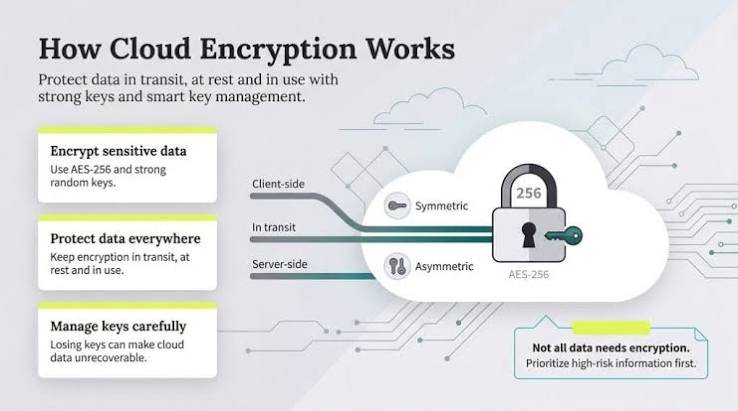
Cloud encryption works by using mathematical algorithms to transform readable information into ciphertext. When data is uploaded to a cloud platform, encryption software applies a specific method and uses an encryption key to protect it. When an authorized person needs the information, the appropriate decryption key converts the ciphertext back into readable data. Depending on the service, encryption may happen before uploading, during transmission, or after the information reaches the cloud server. The exact process depends on the provider’s security design and the user’s configuration.
4. Types of Cloud Encryption
There are several types of cloud encryption, and each serves a different purpose. Symmetric encryption uses the same key to encrypt and decrypt information, making it efficient for protecting large amounts of data. Asymmetric encryption uses a public key and a private key to support secure communication and other security functions. Another important category is end-to-end encryption, which is designed to keep information protected so that only intended endpoints can access its contents. Choosing the appropriate approach depends on the sensitivity of the information, performance requirements, and overall security objectives.
5. Encryption at Rest
Encryption at rest protects information while it is stored on cloud servers, databases, backup systems, or other storage devices. If someone gains unauthorized access to the underlying storage, the encrypted information should remain unreadable without the necessary decryption key. This protection is particularly valuable for businesses that maintain customer records, confidential reports, and sensitive documents. Many cloud providers offer built-in encryption for stored data, although the available settings and level of control can vary. Organizations should review these options to ensure that their stored information receives suitable protection.
6. Encryption in Transit
Encryption in transit protects information as it travels between a user’s device and a cloud service or between different systems. For example, when someone uploads a document through a secure connection, encryption helps prevent outsiders from reading the information while it moves across a network. Technologies such as Transport Layer Security (TLS) are commonly used to protect data transmitted over the internet. However, encryption in transit does not automatically guarantee that information remains encrypted after reaching its destination. Combining it with encryption at rest provides more comprehensive protection.
7. Cloud Encryption and Data Privacy
Data privacy is one of the main reasons organizations adopt cloud encryption. Businesses often collect personal information that must be handled carefully and accessed only by authorized people. Encryption helps reduce the chance of exposing readable information during certain security incidents. It can also support privacy obligations under applicable laws and industry regulations. However, encryption alone does not guarantee compliance or complete privacy. Organizations must also establish clear access policies, limit unnecessary data collection, monitor activity, and ensure that sensitive information is managed responsibly throughout its lifecycle.
8. Benefits of Cloud Encryption for Businesses
Cloud encryption offers several practical benefits for organizations of different sizes. It helps protect confidential files, reduces the potential impact of data exposure, and strengthens overall cybersecurity practices. It can also support secure collaboration by allowing authorized employees to access protected information through approved systems. For companies that depend on cloud applications, encryption is an important part of maintaining customer confidence and protecting business operations. When implemented correctly, it works alongside other security controls to create a stronger defense against unauthorized access and data misuse.
9. Cloud Encryption and Encryption Key Management
Encryption keys are essential because they determine who can encrypt or decrypt protected information. If keys are lost, legitimate users may lose access to their data. If keys are stolen or poorly protected, attackers may be able to access encrypted information. Effective key management includes generating strong keys, restricting access, rotating keys when appropriate, and maintaining secure backups. Some organizations use a cloud provider’s key management service, while others choose to manage their own keys for greater control. The right approach depends on technical expertise, risk tolerance, and compliance requirements.
10. Common Challenges of Cloud Encryption
Although cloud encryption improves security, implementing it can introduce certain challenges. Managing multiple encryption keys may become complicated as an organization expands its cloud infrastructure. Encryption can also require additional computing resources, although modern systems are generally designed to handle many encryption tasks efficiently. Another challenge involves balancing strong security with convenient access for employees and customers. Businesses must also understand how encryption interacts with backups, search functions, integrations, and recovery procedures. Careful planning and regular testing can help address these concerns without unnecessarily disrupting daily operations.
11. Best Practices for Cloud Encryption
Organizations can improve their cloud security by following a few essential practices. They should choose reputable encryption methods, enable secure connections, and understand whether their cloud provider encrypts stored information by default. Access to encryption keys should be limited to trusted users and systems, with multi-factor authentication used where appropriate. Regular security assessments can help identify weaknesses in configurations and access permissions. Businesses should also maintain reliable backups, document recovery procedures, and train employees to recognize common security threats. These measures help make encryption more effective as part of a broader security strategy.
12. The Future of Cloud Encryption
The future of cloud encryption will continue to evolve alongside advances in cloud computing, artificial intelligence, and cybersecurity. Organizations are exploring improved key management systems, confidential computing, and privacy-enhancing technologies that help protect information during different stages of processing. Post-quantum cryptography is also receiving attention because future quantum computers could threaten some widely used public-key cryptographic systems. These developments may change how businesses protect sensitive information over time. Staying informed about emerging technologies and updating security practices will help organizations prepare for changing risks.
Conclusion
Cloud encryption is a valuable technology for protecting digital information in an increasingly connected world. It helps safeguard data while it is stored and transmitted, making unauthorized access more difficult. However, its effectiveness depends on proper implementation, secure key management, and suitable access controls. Businesses should evaluate their security requirements carefully and choose encryption solutions that fit their needs. By combining cloud encryption with regular monitoring, employee awareness, and reliable recovery plans, organizations can strengthen data protection and build greater confidence in their cloud services.
Frequently Asked Questions (FAQs)
1. What is cloud encryption used for?
Cloud encryption is used to protect information stored on cloud platforms and data transmitted between devices and cloud services. It converts readable information into an encrypted format that requires the appropriate key to access.
2. Is cloud encryption completely secure?
No security method is completely foolproof. Cloud encryption significantly improves data protection, but weak key management, compromised accounts, incorrect configurations, and insecure applications can still create risks. It works best alongside other security measures.
3. What is the difference between encryption at rest and encryption in transit?
Encryption at rest protects information while it is stored on cloud servers or storage systems. Encryption in transit protects information as it moves across networks between devices, applications, and cloud services. Using both helps provide broader data protection.